The Classification of Congenital Malformation of Uterus
How Many Types Are There?
Diploma in Gynecologic Endoscopic Surgery, MClinEmbryol,
EFOG-EBCOG., EFRM-ESHRE/EBCOG.
I have worked with infertility patients for more than 10 years. I once collected data on how often Thai patients with infertility who came to see me had a congenital malformation of the uterus (CMU). It turned out that as many as 30% of Thai patients with infertility had a congenital uterine anomaly on 3D ultrasound, which is very common. Most of the patients in this group had already seen several doctors and had a lot of treatment, which usually did not succeed at all or sadly ended in miscarriage.
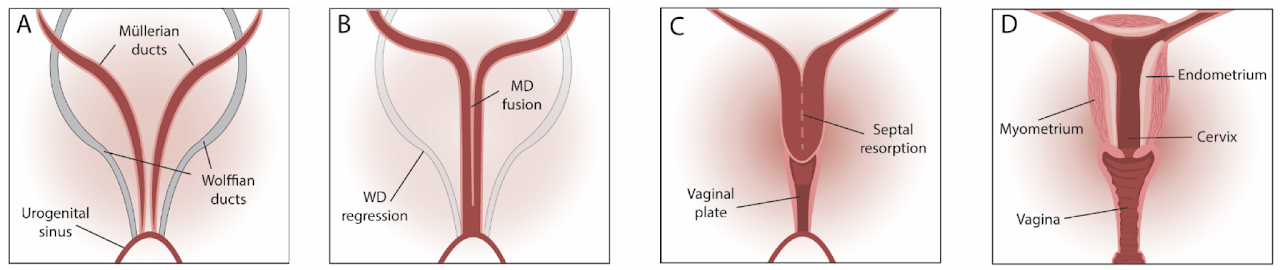
The uterus forms when the two Müllerian ducts join together and the wall between the two ducts breaks down, as shown in Figure 1.
So a problem at any step of uterine development can lead to a congenital uterine anomaly. For example, a uterine septum is thought to happen when the wall between the two ducts does not break down, or does not break down completely. Uterine didelphys happens when the Müllerian ducts do not join properly.
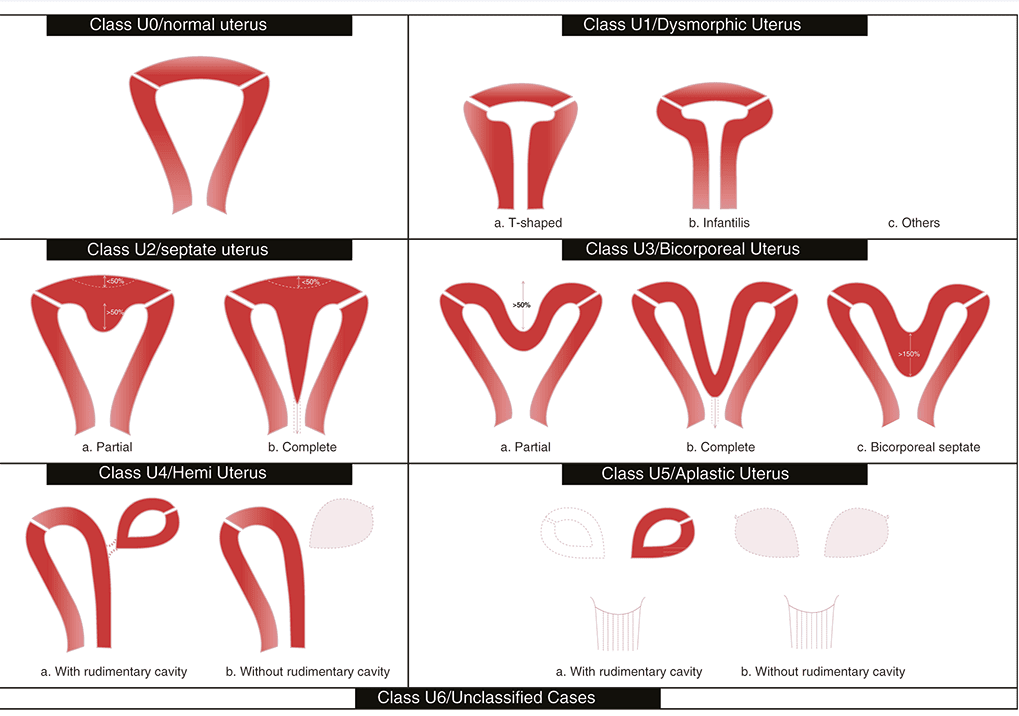
Because there are many types of anomalies, several organizations have tried to classify them systematically, to keep examination, diagnosis, treatment and research organized and to build more knowledge. Personally, I prefer the ESHRE/ESGE system, published in 2013 (B.E. 2556), as shown in Figure 2.
U0 normal uterus
U1 Dysmorphic uterus
U2 Septate uterus
U3 Bicorporeal uterus
U4 Hemiuterus
U5 Aplastic uterus
U6 Unclassified cases
As Figure 2 shows, a dysmorphic uterus is Class U1 Dysmorphic uterus.
With best wishes,
Dr. Patsama
Leave a comment
* This article is general health education. Diagnosis and treatment should be guided by your doctor. Results vary with age and individual medical factors.
Dr. Patsama Vichinsartvichai, MD, MClinEmbryol, EFOG-EBCOG, EFRM-ESHRE/EBCOG, FACOG is a board-certified reproductive endocrinology & infertility specialist, former head of the Vajira IVF unit at Navamindradhiraj University, and founder of LIFE by Dr. Pat in Bangkok. His published research focuses on the dysmorphic (T-shaped) uterus and uterine-factor infertility.
 LIFE by Dr. Pat