In my previous article, I summarized the key points of the Protection of Children Born through Assisted Reproductive Technologies Act B.E. 2558 (2015) (พระราชบัญญัติคุ้มครองเด็กที่เกิดโดยอาศัยเทคโนโลยีช่วยการเจริญพันธุ์ทางการแพทย์ พ.ศ. 2558). Like most major laws, it needs secondary legislation, subordinate regulations and so on to expand on its definitions and the small details that cannot fit into the main Act. Did you know that the Act B.E. 2558 (2015) now has as many as 23 related notifications in total, issued by the Ministry of Public Health, the Committee for the Protection of Children Born through Assisted Reproductive Technologies, the Medical Council of Thailand and the Central Registration Office?
Gestational surrogacy is done by preparing the uterine lining of the woman who will carry the pregnancy, just as we would for an embryo transfer. Put simply, it is roughly like borrowing someone else's uterus to carry the pregnancy. As for the legal steps, let's go through them in this article.
Notifications related to gestational surrogacy
First, let's look at the notifications related to gestational surrogacy. Apart from the main Act itself, there are as many as 8 of them:
Protection of Children Born through Assisted Reproductive Technologies Act B.E. 2558 (2015)
Ministry of Public Health Notification Re: Criteria, Procedures and Conditions for Allowing a Woman Who Is Not a Blood Relative of the Lawful Husband or Wife to Act as a Gestational Carrier, B.E. 2558 (2015) (ประกาศกระทรวงสาธารณสุข เรื่อง หลักเกณฑ์ วิธีการ และเงื่อนไขในการให้หญิงอื่นที่มิใช่ญาติสืบสายโลหิตของสามีหรือภริยาที่ชอบด้วยกฎหมายรับตั้งครรภ์แทน พ.ศ. 2558)
Ministry of Public Health Notification Re: Criteria, Procedures and Conditions Regarding Surrogacy Agreements and Expenses for the Health Care of the Gestational Carrier During Pregnancy, Termination of the Surrogate Pregnancy, Delivery and After Delivery, Including Expenses for the Health Care of the Child Born through Surrogacy for No Less Than Thirty Days after Birth, B.E. 2558 (2015) (ประกาศกระทรวงสาธารณสุข เรื่อง หลักเกณฑ์ วิธีการ และเงื่อนไขเกี่ยวกับข้อตกลงการตั้งครรภ์แทนและค่าใช้จ่ายในการบํารุงรักษาสุขภาพของหญิงที่รับตั้งครรภ์แทนในขณะตั้งครรภ์ การยุติการตั้งครรภ์แทน การคลอด และหลังคลอด รวมทั้งค่าใช้จ่ายในการดูแลสุขภาพของเด็กที่เกิดจากการตั้งครรภ์แทน หลังคลอดเป็นเวลาไม่น้อยกว่าสามสิบวัน พ.ศ. 2558)
Notification of the Committee for the Protection of Children Born through Assisted Reproductive Technologies Re: Criteria, Procedures and Conditions for Applying for and Granting Permission to Assisted Reproductive Technology Service Providers to Perform Gestational Surrogacy, B.E. 2558 (2015) (ประกาศ กคทพ. เรื่อง หลักเกณฑ์ วิธีการ และเงื่อนไขในการขออนุญาตและการอนุญาตให้ผู้ให้บริการเกี่ยวกับเทคโนโลยีช่วยเจริญพันธุ์ทางการแพทย์ดําเนินการให้มีการตั้งครรภ์แทน พ.ศ. 2558)
Notification of the Committee for the Protection of Children Born through Assisted Reproductive Technologies Re: Criteria, Procedures and Conditions for Applying for and Granting Permission to Assisted Reproductive Technology Service Providers to Perform Gestational Surrogacy (No. 2), B.E. 2562 (2019) (ประกาศ กคทพ. เรื่อง หลักเกณฑ์ วิธีการ และเงื่อนไขในการขออนุญาตและการอนุญาตให้ผู้ให้บริการเกี่ยวกับเทคโนโลยีช่วยเจริญพันธุ์ทางการแพทย์ดำเนินการให้มีการตั้งครรภ์แทน (ฉบับที่ 2) พ.ศ. 2562)
Notification of the Committee for the Protection of Children Born through Assisted Reproductive Technologies Re: Criteria, Procedures and Conditions for Applying for and Granting Permission to Assisted Reproductive Technology Service Providers to Perform Gestational Surrogacy (No. 3), B.E. 2566 (2023) (ประกาศ กคทพ. เรื่อง หลักเกณฑ์ วิธีการ และเงื่อนไขในการขออนุญาตและการอนุญาตให้ผู้ให้บริการเกี่ยวกับเทคโนโลยีช่วยการเจริญพันธุ์ทางการแพทย์ดำเนินการให้มีการตั้งครรภ์แทน (ฉบับที่ 3) พ.ศ. 2566)
Medical Council of Thailand Notification Re: Criteria, Procedures and Conditions for Examining and Assessing the Physical, Mental and Environmental Readiness of Service Recipients, Gestational Carriers, and Sperm or Egg Donors Who Will Take Part in Providing Assisted Reproductive Technology Services, B.E. 2558 (2015) (ประกาศแพทยสภา เรื่อง หลักเกณฑ์ วิธีการ และเงื่อนไขสําหรับการตรวจและประเมินความพร้อมทางด้านร่างกาย จิตใจ และสภาพแวดล้อมของผู้ขอรับบริการ หญิงที่รับตั้งครรภ์แทน และผู้บริจาคอสุจิหรือไข่ ที่จะนํามาใช้ดําเนินการให้บริการเกี่ยวกับเทคโนโลยีช่วยการเจริญพันธุ์ทางการแพทย์ พ.ศ. 2558)
Medical Council of Thailand Notification Re: Criteria, Procedures and Conditions for Termination of a Surrogate Pregnancy, B.E. 2558 (2015) (ประกาศแพทยสภา เรื่อง หลักเกณฑ์ วิธีการ และเงื่อนไขเกี่ยวกับการยุติการตั้งครรภ์แทน พ.ศ. 2558)
Central Registration Office Notification Re: Criteria, Procedures and Conditions for Notifying the Birth of a Child Born through Gestational Surrogacy Using Assisted Reproductive Technology, B.E. 2558 (2015) (ประกาศสำนักทะเบียนกลาง เรื่อง หลักเกณฑ์วิธีการ และเงื่อนไขการแจ้งการเกิดของเด็กที่เกิดจากการตั้งครรภ์แทนโดยอาศัยเทคโนโลยีช่วยการเจริญพันธุ์ทางการแพทย์ พ.ศ. 2558)
In this article, I will also add reference numbers to show which notification, or the Act itself, each requirement comes from, using the same numbering as the list above, so you can trace where each rule comes from.
Who can legally apply to use gestational surrogacy
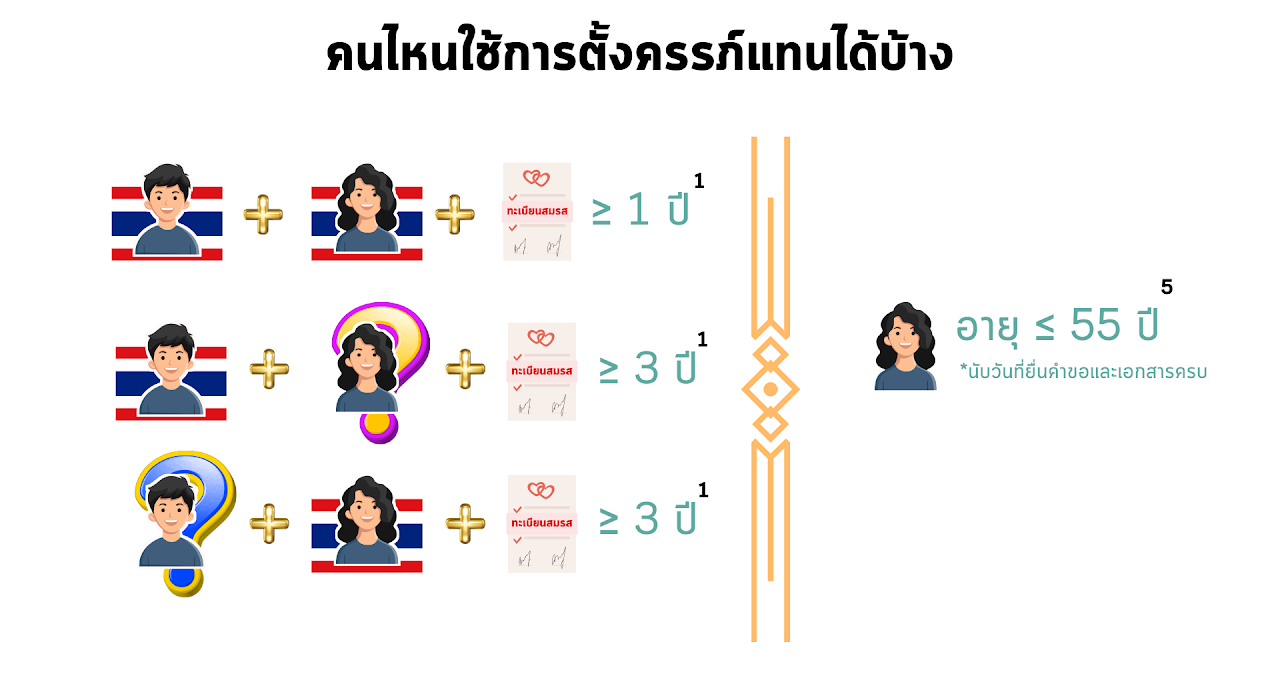
Applicants for gestational surrogacy must meet these requirements:
Be a lawfully married couple (with a marriage registration)
At least the husband or the wife must have Thai nationality (if the husband or wife is not a Thai national, the couple must have been registered as married for at least 3 years before they can apply for gestational surrogacy)
The wife must be no older than 55 on the date all documents are submitted
Figure 1. Basic eligibility requirements for those entitled to request gestational surrogacy
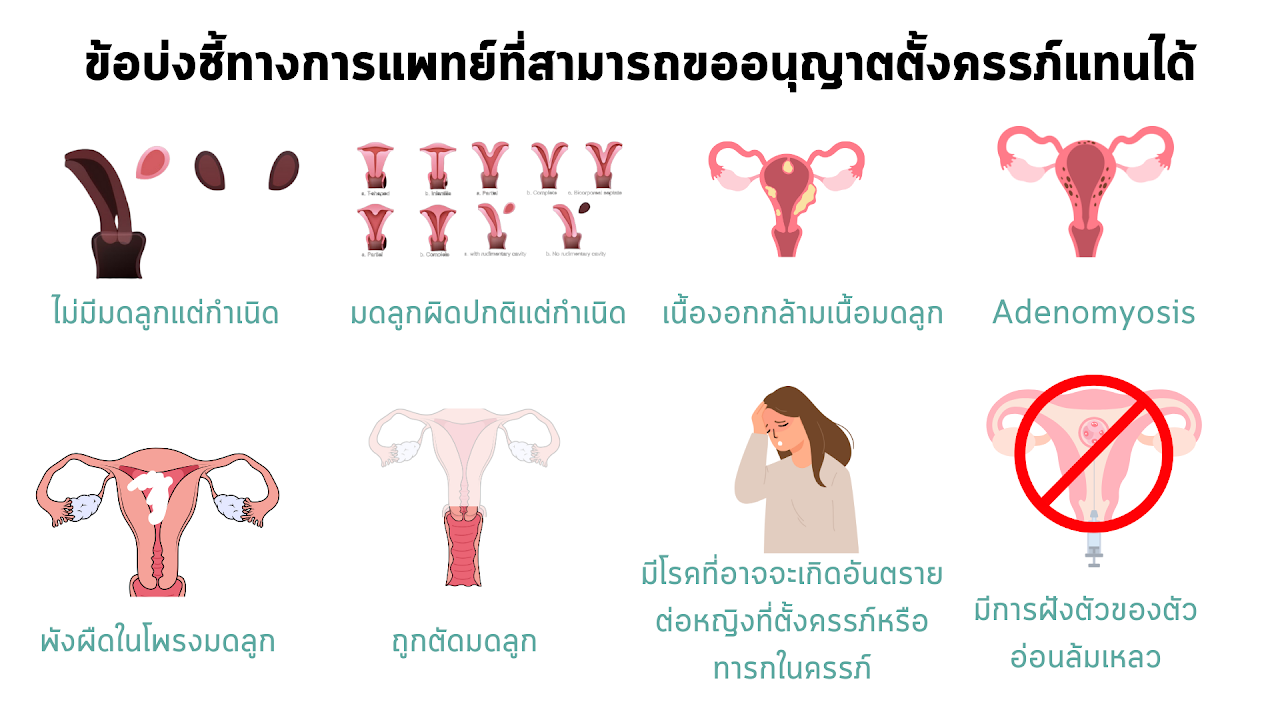
Medical indications for gestational surrogacy
The medical indications for using gestational surrogacy are shown in Figure 2.
Figure 2. Medical indications for gestational surrogacy
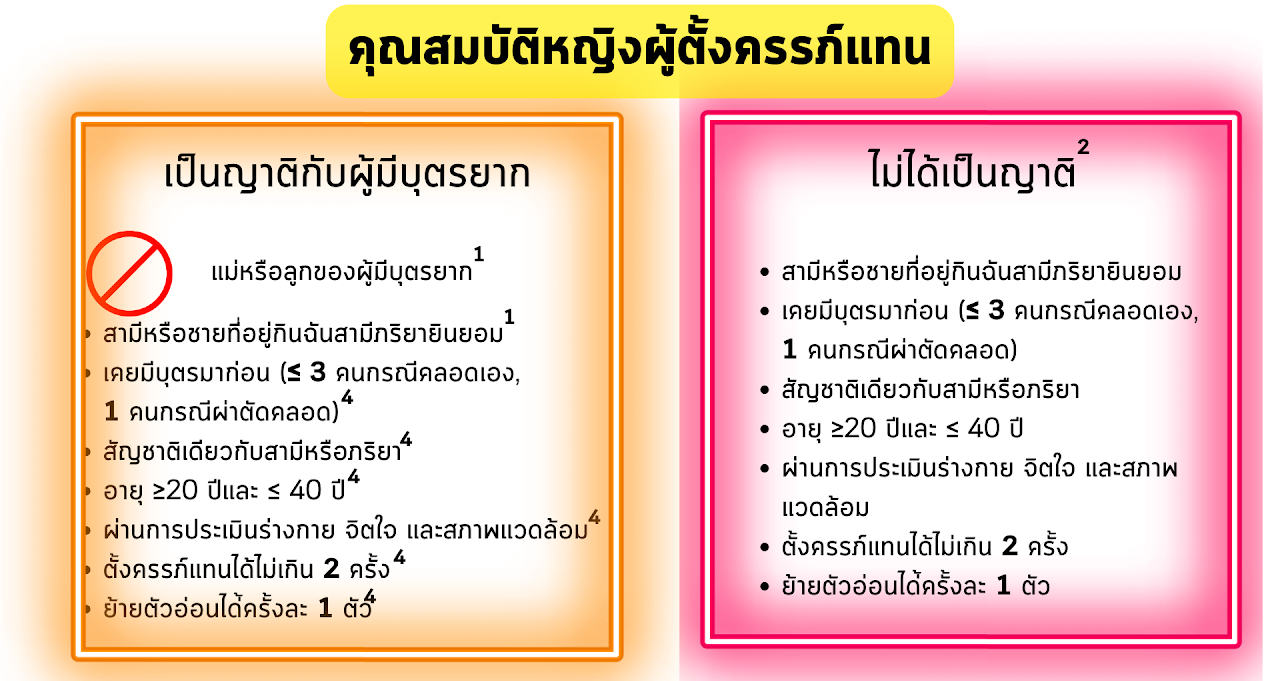
Requirements for the gestational carrier
If she is a blood relative
In general, the law recommends using a blood relative of the couple first, but she must not be the mother or the daughter of either spouse. She must be aged 20-40, with no more than 1 previous cesarean delivery or no more than 3 previous vaginal deliveries (Figure 3).
If she is not a blood relative
If there is no female relative who meets all the requirements to carry the pregnancy, don't panic. You can find anyone who is willing to carry the pregnancy for you. The requirements are much the same as for a blood relative (Figure 3).
Figure 3. Requirements for the gestational carrier
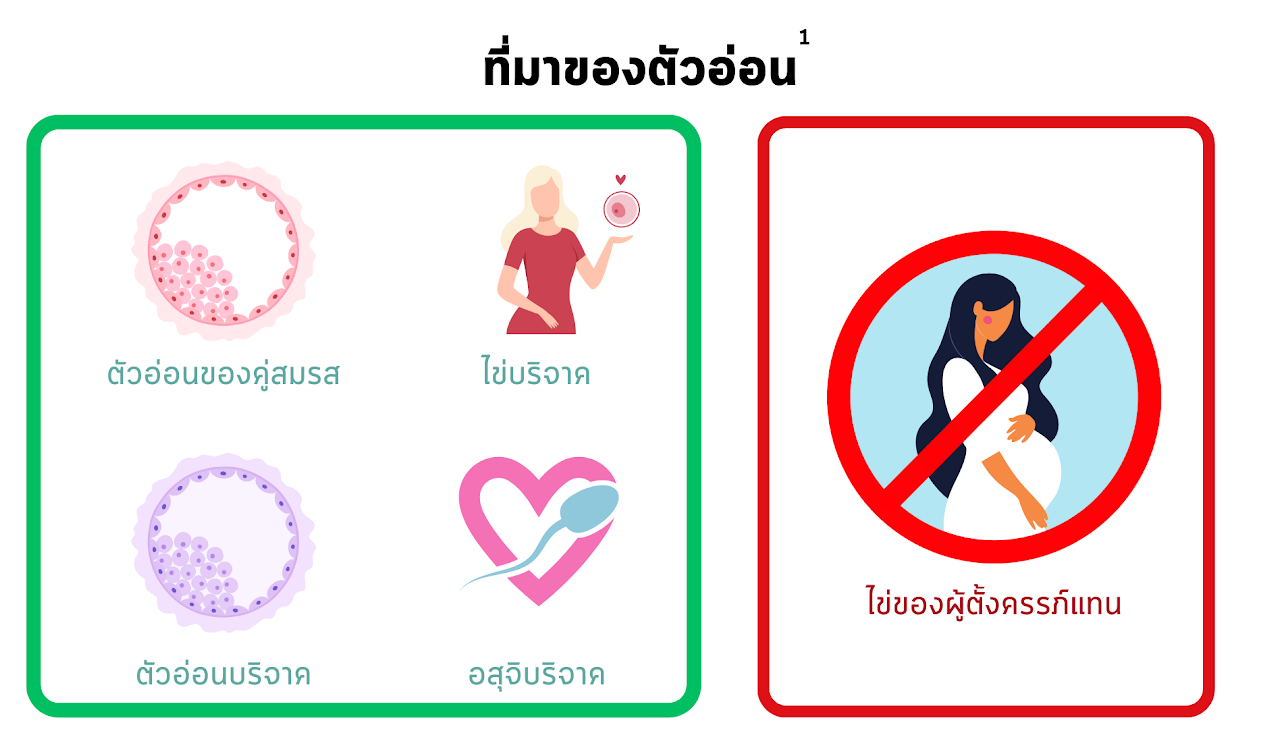
Where the embryo comes from
The embryo may come from the couple's own eggs and sperm, a donated embryo, donated eggs or donated sperm. However, the gestational carrier's own eggs cannot be used.
Figure 4. Sources of the embryos transferred in gestational surrogacy
Steps to apply for gestational surrogacy
Gestational surrogacy involves the following steps:
The treating physician and the medical facility determine that there is an indication for gestational surrogacy.
The physical health, mental health and environment of the woman who will carry the pregnancy are assessed.
An application is submitted to the medical facility's ethics committee for review.
An application is submitted to the Committee for the Protection of Children Born through Assisted Reproductive Technologies, Department of Health Service Support, Ministry of Public Health (กคทพ.).
After the Committee approves the surrogacy, an approval document is sent to the medical facility (this document is also used to register the child's birth). Only then can preparation of the uterine lining for embryo transfer begin.
The whole process takes about 4-6 months.
Note: Approval for gestational surrogacy is specific to the married couple, the woman who will carry the pregnancy, and the medical facility. This means that if any one of them changes, for example a change of medical facility or a change of gestational carrier, new documents must be prepared to seek approval from the Committee again.
What the intended parents are responsible for toward the gestational carrier
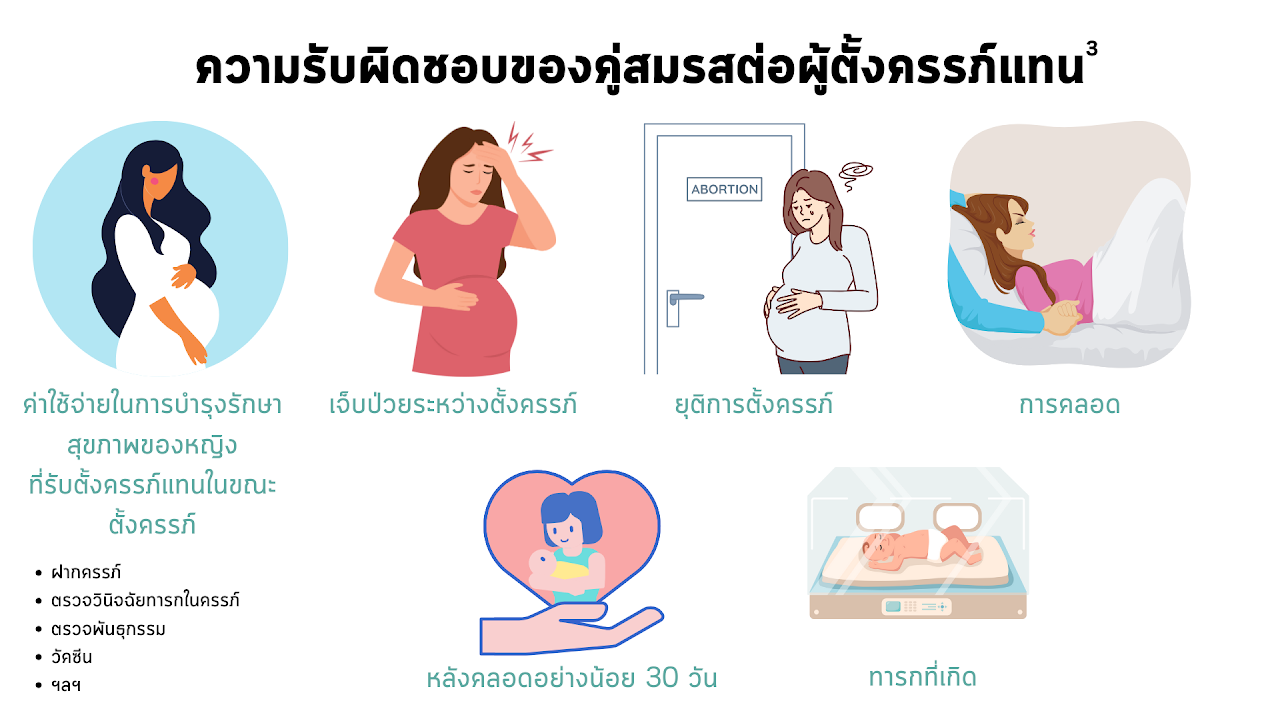
Gestational surrogacy is like entrusting your child to someone else's care. Trust and mutual kindness matter a great deal. By law, the married couple is responsible for the following expenses related to the gestational carrier (Figure 5):
Health care expenses for the gestational carrier during pregnancy: antenatal care, fetal diagnostic testing, prenatal genetic testing of the fetus, vaccines, etc.
Illness during pregnancy
Termination of pregnancy
Delivery
The baby
Expenses after delivery for at least 30 days
Figure 5. The married couple's responsibilities toward the gestational carrier
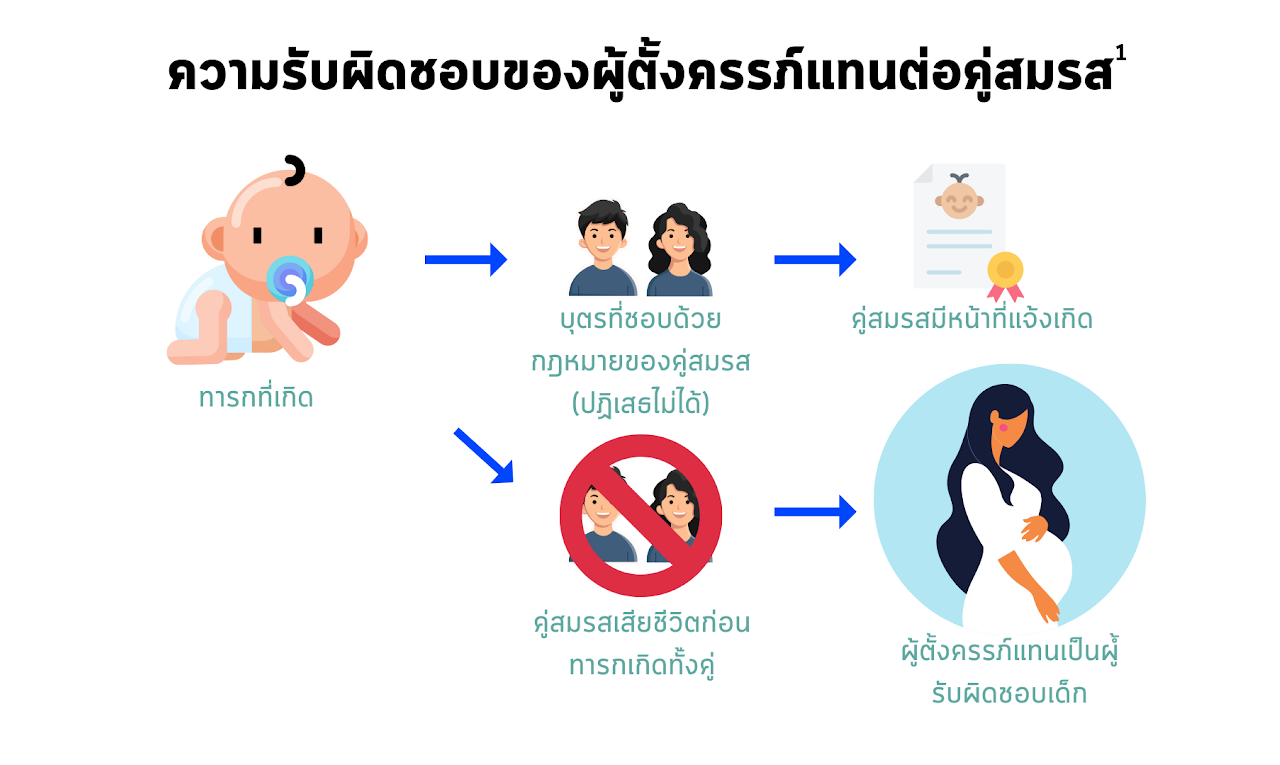
Responsibilities of the gestational carrier
The gestational carrier also has responsibilities, including (Figure 6):
Helping her own children understand the surrogacy
Looking after her health as usual (the notification uses the phrase "as a reasonable person would")
In addition, in the unfortunate event that both spouses die before the child is born, the gestational carrier must take responsibility for the child until there is a further court order
Figure 6. Responsibilities of the gestational carrier
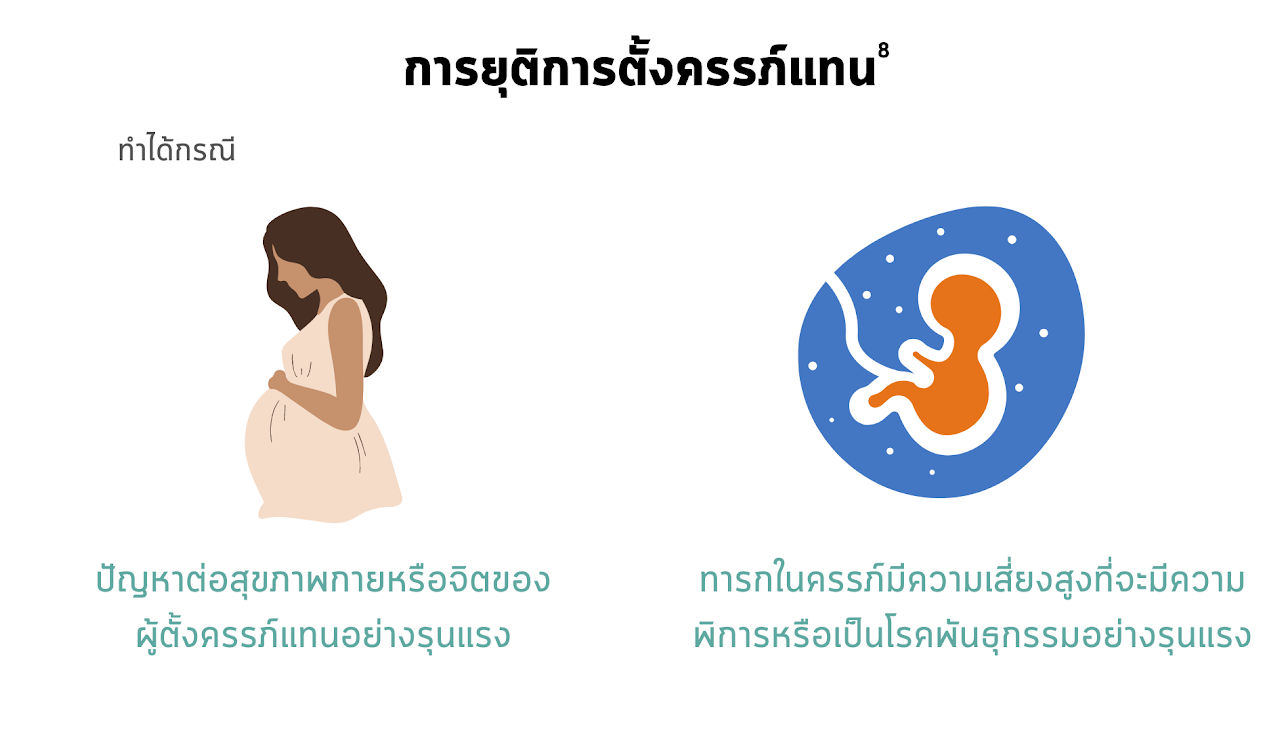
Termination of a surrogate pregnancy
All good things must come to an end. A surrogate pregnancy does not always end in delivery. A surrogate pregnancy may be terminated in these cases:
A serious physical or mental health problem for the gestational carrier
The fetus is at high risk of a serious disability or a serious genetic disease
Figure 7. Indications for terminating a surrogate pregnancy
Summary
Gestational surrogacy helps people with infertility succeed in having a child more easily in many conditions. In addition, if the procedures required by law are not followed, there may be penalties, whether imprisonment or a fine. But the advantage is that the child born is legally the married couple's child in every respect, exactly as if they had given birth themselves.
* This article is general health education. Diagnosis and treatment should be guided by your doctor. Results vary with age and individual medical factors.
Dr. Patsama Vichinsartvichai, MD, MClinEmbryol, EFOG-EBCOG, EFRM-ESHRE/EBCOG, FACOG is a board-certified reproductive endocrinology & infertility specialist, former head of the Vajira IVF unit at Navamindradhiraj University, and founder of LIFE by Dr. Pat in Bangkok. His published research focuses on the dysmorphic (T-shaped) uterus and uterine-factor infertility.
 LIFE by Dr. Pat