With current technology, preimplantation genetic testing for aneuploidy (PGT-A) requires the DNA to be copied many times before analysis (whole genome amplification) so that there is enough DNA to analyze. This creates a chance of copying errors. In addition, differences in embryo quality also affect the quality of the DNA extracted for testing.
What Is Mosaicism?
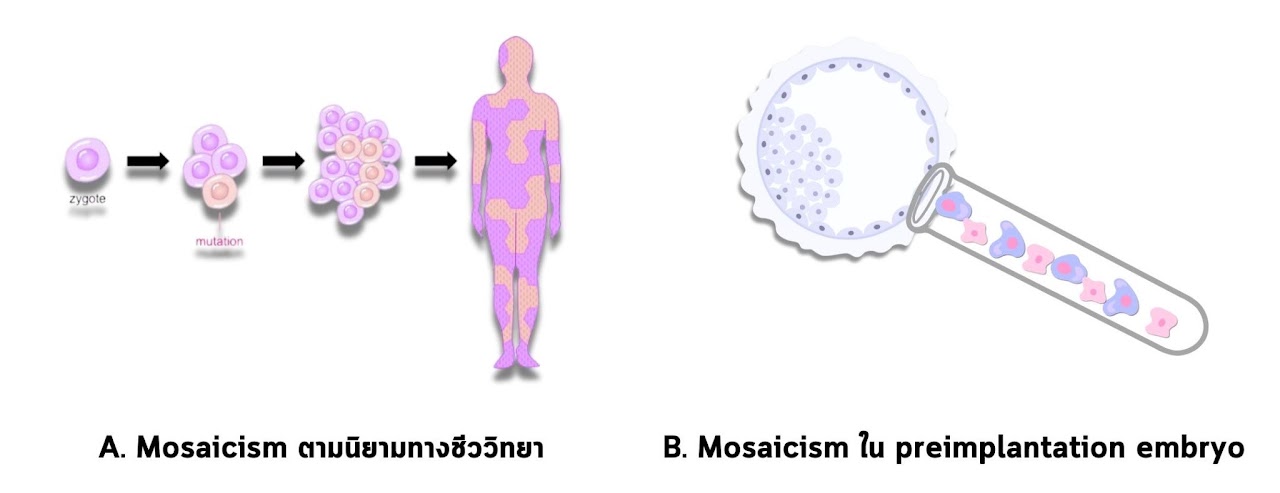
Mosaicism means that an organism has a mix of cells with a normal chromosome number and cells with an abnormal chromosome number, as shown in Figure 1A. For an embryo that has cells biopsied for testing before transfer, mosaicism means that the cells in the biopsied sample do not all have the same chromosome set. It does not mean that the whole embryo has different chromosome patterns throughout, as shown in Figure 1B.
Figure 1. A. The commonly understood biological definition of mosaicism: an organism with cells that carry different chromosome sets, for example both cells with normal chromosomes and cells with some chromosome pairs missing or extra. B. The definition of mosaicism used in PGT-A: the chromosome result from the embryo cells biopsied for testing shows a mix of normal and abnormal chromosome patterns.
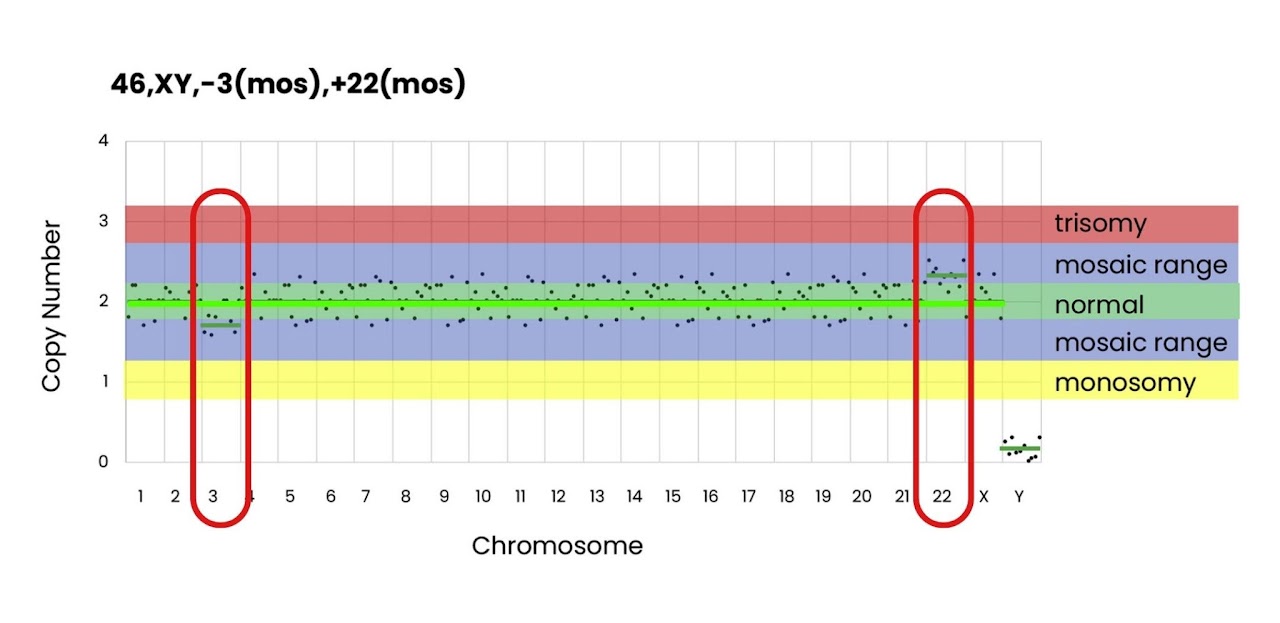
Several technologies are used to analyze the number of chromosomes in embryos. The one that is widely used and not too expensive is next-generation sequencing (NGS). Its results are reported as intermediate copy number, which shows how many times more DNA each chromosome pair has compared with a reference (Figure 2). For example:
If it is 2 times, that chromosome pair has 2 chromosomes, which is the normal number. If the copy number is 3, that chromosome pair has 3 chromosomes, which is 1 extra, meaning trisomy. If the copy number is 1, that chromosome pair is missing 1 chromosome, meaning monosomy.
The problem is that in some cases the copy number does not fall exactly on the 1, 2 or 3 line. It falls between these values, so it is not possible to tell how many chromosome copies the embryo really has. Because of this, an intermediate copy number threshold of 20-80% was set. This means:
If the result deviates above or below the normal point by no more than 20%, the chromosome is considered normal (euploid).
If the result is abnormal by more than 80%, the chromosome number is considered abnormal (aneuploid).
If the abnormal value is between 20-80%, it should really be called an unknown result, but it has been defined as a mosaic result for that chromosome pair. This means there may be a mix of cells with a normal and an abnormal number of that chromosome.
Figure 2. The intermediate copy number thresholds that indicate a mosaic chromosome result in an embryo. Chromosome 3 falls in the mosaic monosomy range, and chromosome 22 is a mosaic trisomy.
Image source: Treff, Nathan R. et al. The “mosaic” embryo: misconceptions and misinterpretations in preimplantation genetic testing for aneuploidy. Fertility and Sterility, Volume 116, Issue 5, 1205 - 1211.
So people started to wonder: is an embryo with a mosaic result actually normal or abnormal? Researchers studied this further by taking cells from these embryos at many different points for testing. (This cannot be done with your own embryos. The embryo would not survive.) They found that almost 60% of these embryos were not truly mosaic: 28.3% had abnormal chromosomes and 29% had normal chromosomes. Later studies also found that transferring embryos with a low level of mosaicism (<50%) gave pregnancy outcomes no different from embryos with normal chromosomes (euploid).
Causes of Mosaicism
A mosaic chromosome result may not mean the embryo is truly abnormal. This means that a fair number of embryos with a mosaic result are false positives. These results that do not match the real embryo have several causes:
Embryo cells are damaged during the biopsy. The biopsy may not remove whole cells. Some cells may be partly torn, so pieces of some chromosomes are lost.
Too few cells are biopsied. The starting amount of DNA is small, and copying of DNA in some regions can be slower and uneven compared with other parts of the genome.
Poor handling of the biopsied cells.
The cells are not fully broken down before DNA copying, so some parts of the DNA are not copied as much as others. (This can result from the amplification technique, the validation method and how each lab adapts its methods.)
The embryo corrects its chromosome abnormality (self-correction). The biopsied embryo may truly contain cells with abnormal chromosomes. We usually biopsy the embryo on day 5-6 after ovulation, but human embryos have been found to be able to correct abnormal chromosomes up to day 8 after ovulation.
Interpretation, by both the analysis software and the person reading the result.
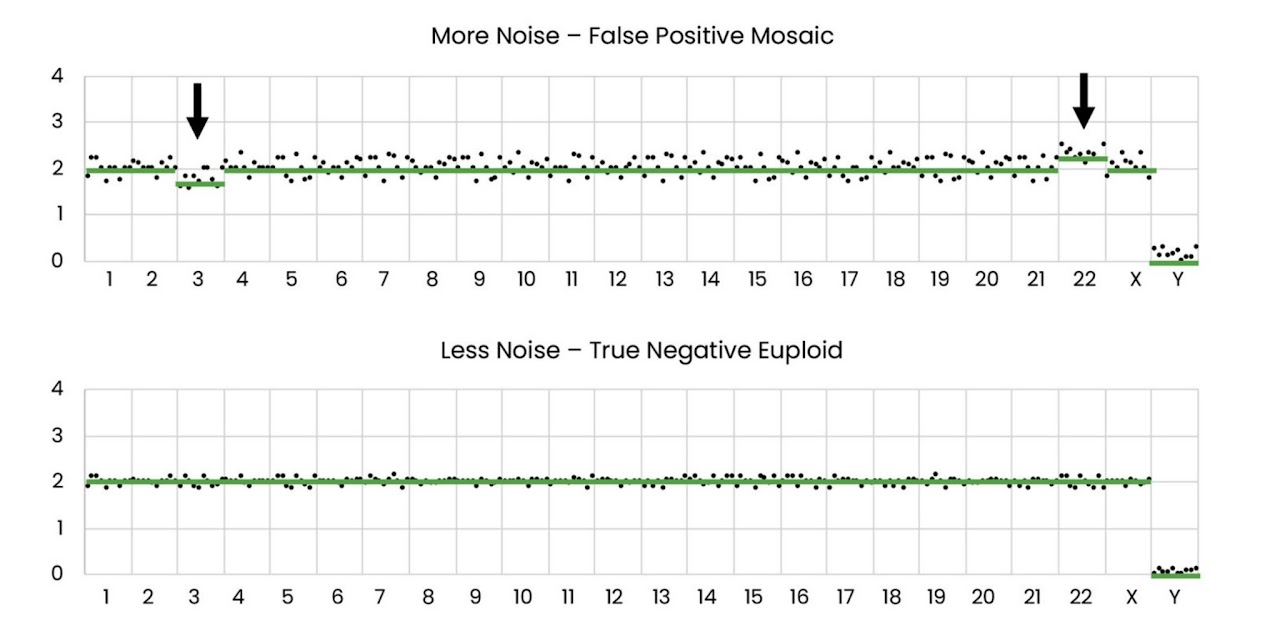
Noise in the reading. Noise makes the line that shows the chromosome number uneven and can lead to a wrong reading, as shown in Figure 3.
Figure 3. The effect of noise on the accuracy of predicting normal chromosomes (low noise) and the error rate when predicting mosaicism (high noise).
Image source: Treff, Nathan R. et al. The “mosaic” embryo: misconceptions and misinterpretations in preimplantation genetic testing for aneuploidy.Volume 116, Issue 5, 1205 - 1211, Fertility and Sterility 2021.
What to Consider Before Transferring a Mosaic Embryo
There are three issues to consider.
What happens if the embryo is truly mosaic?
What actually happens when embryos with a mosaic result are transferred?
Which kinds of mosaic embryos can be transferred?
What happens if the embryo is truly mosaic?
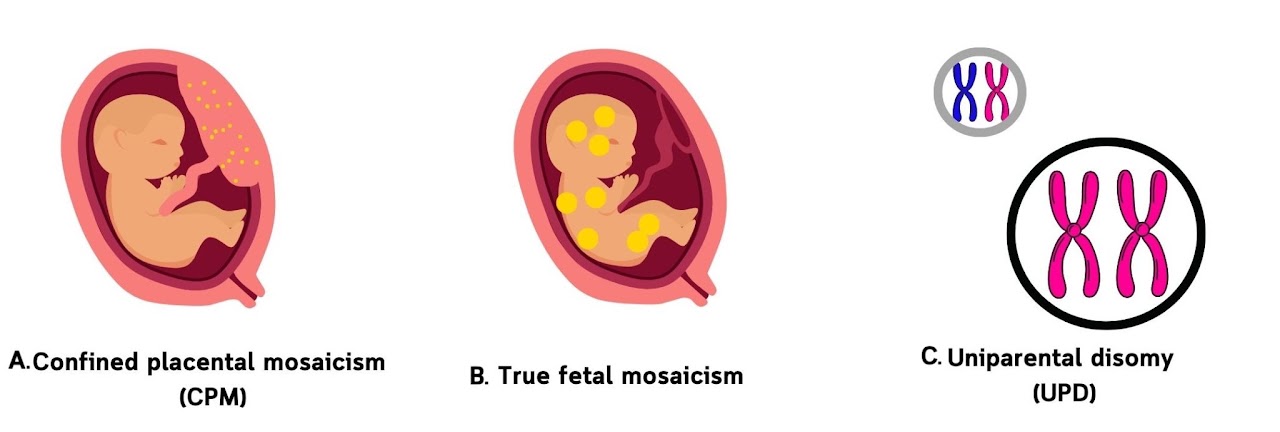
Next, a patient may think: the chance of true mosaicism may be small, but what happens if the embryo is transferred and the child really does have mosaic chromosomes? In theory, if an embryo is truly mosaic, there are 3 possible outcomes, as shown in Figure 4.
Figure 4. The theoretical effects of an embryo with a mosaic chromosome result. A. Confined placental mosaicism (CPM): cells with a truly mosaic chromosome result are found, but only in the placenta. B. True fetal mosaicism: the baby itself truly has mosaic chromosomes. C. Uniparental disomy (UPD): the embryo corrects the chromosome abnormality, so the baby ends up with a normal chromosome number, but both remaining chromosomes of that pair come from only one parent.
Image source: adapted from Clinical management of mosaic results from preimplantation genetic testing for aneuploidy (PGT-A) of blastocysts: a committee opinion. Fertility and Sterility 2020.
1.1 Confined placental mosaicism (CPM) means that cells with a truly mosaic chromosome result are found, but only in the placenta. The baby's chromosomes are normal. This occurs in 2% of pregnancies in general. In most of these pregnancies, no problems are found during pregnancy or birth. However, there may be a higher risk of miscarriage and fetal growth restriction. These complications depend on which cells in the placenta are affected.
1.2 True fetal mosaicism means that the baby truly has mosaic chromosomes. The chromosomes most often found to be mosaic are an extra chromosome 21 or 18, and sex chromosome (X and Y) abnormalities, whether missing or extra. Babies with mosaic chromosomes who also have abnormalities seen on ultrasound have a high risk of abnormal development or physical abnormalities. The effects vary from case to case, depending on the proportion of cells with abnormal chromosomes in each organ. However, there are reports of babies with mosaic chromosomes who have no abnormalities at all.
1.3 Uniparental disomy (UPD) means that the embryo corrects the chromosome abnormality, so the baby ends up with a normal chromosome number, but both remaining chromosomes of that pair come from only one parent. UPD usually does not cause any specific abnormal features, but specific abnormalities may occur if UPD involves chromosomes 6, 7, 11, 14,15, 2, 16, and 20. In addition, if the 2 chromosomes come from the same single chromosome copy, a recessive genetic disease may occur.
2. What actually happens when embryos with a mosaic result are transferred?
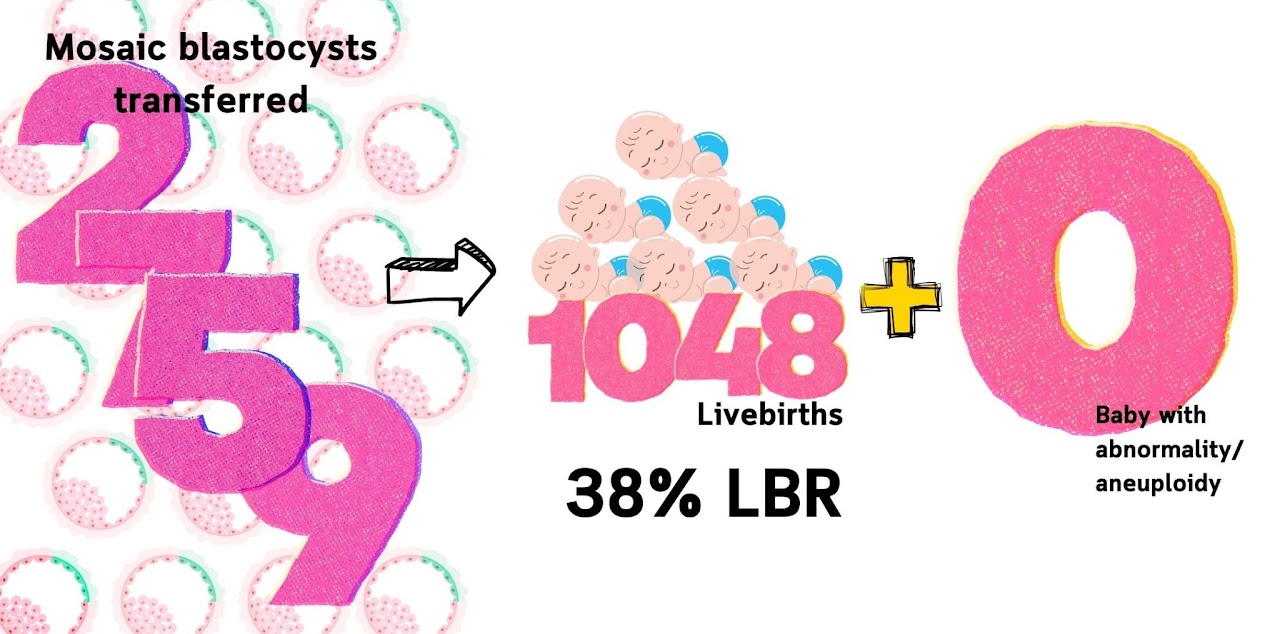
Figure 5. Treatment outcomes of 2,759 transferred embryos with a mosaic chromosome result reported in research.
Image source: adapted from Treff, Nathan R. et al. The “mosaic” embryo: misconceptions and misinterpretations in preimplantation genetic testing for aneuploidy.Volume 116, Issue 5, 1205 - 1211, Fertility and Sterility 2021.
Today, research reporting the outcomes of more than 2,700 mosaic embryo transfers shows that more than 1,000 babies have been born from these embryos. That is a live birth rate of 38%, and none of the babies had an abnormality. Only 1 case was confirmed to have truly mosaic chromosomes (Figure 5). So what causes mosaic embryos, which ones can be transferred, and which ones should not be? Let's look further.
3. Which kinds of mosaic embryos can be transferred?
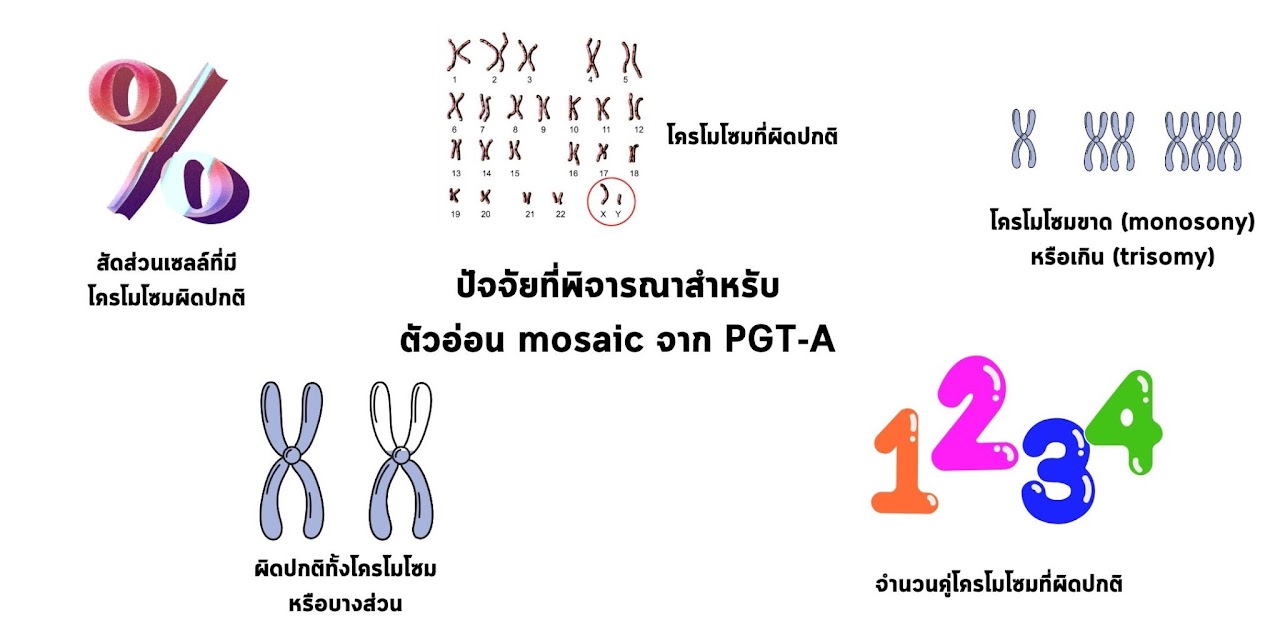
To decide which embryos with a mosaic chromosome result can be transferred and which should not be, there are several factors to consider, as shown in Figure 6.
Figure 6. Factors considered when choosing whether to transfer an embryo with a mosaic PGT-A result.
Image source: adapted from Clinical management of mosaic results from preimplantation genetic testing for aneuploidy (PGT-A) of blastocysts: a committee opinion. Fertility and Sterility 2020.
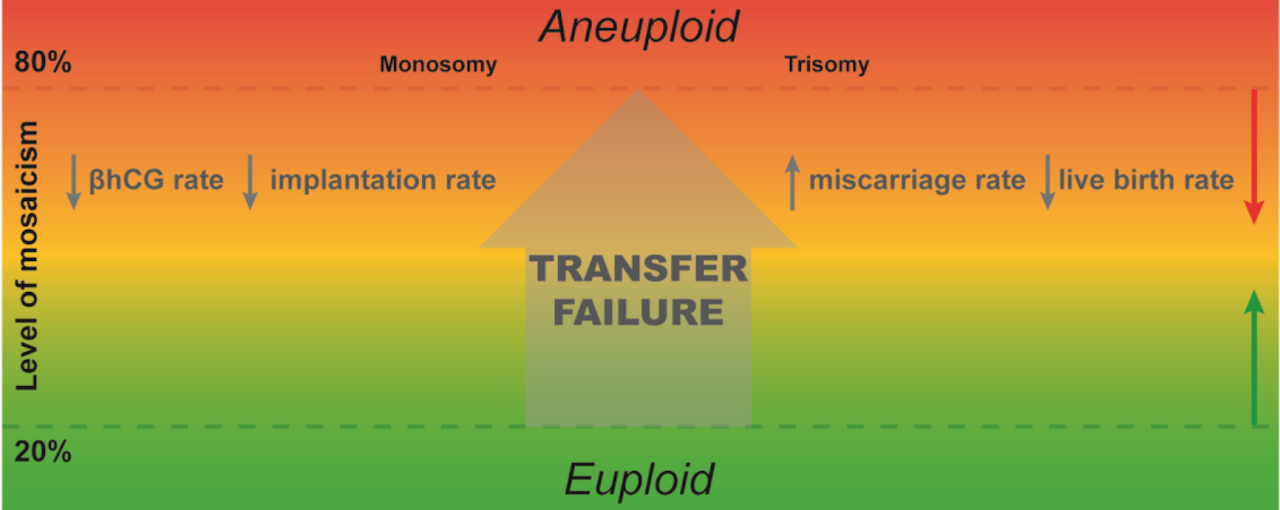
3.1 Proportion of cells with abnormal chromosomes. As I mentioned at the start, we consider an embryo mosaic when the copy number is abnormal by 20-80%. As more of these mosaic embryos have been transferred, we now divide mosaic embryos into 2 groups by %mosaic, as shown in Figure 7.
Low %mosaic means ≤ 50%
High %mosaic means > 50%
Figure 7. The relationship between the proportion of cells with abnormal chromosomes on PGT-A and pregnancy outcomes.
Image source: Leigh, D. et al., PGDIS position statement on the transfer of mosaic embryos. Reproductive BioMedicine Online 2021.
Current studies show that for embryos with low %mosaic, the chances of pregnancy and miscarriage are no different from embryos with a normal chromosome result.
3.2 Which chromosome pair is abnormal. If we go by whole-chromosome losses or gains, a loss or gain of some chromosomes is not compatible with life, while a loss or gain of others allows a pregnancy to continue to full term. An example is an extra chromosome 21, which causes Down syndrome. However, studies have found that for mosaic PGT-A results, no matter which chromosome pair is involved, the chances of pregnancy and of delivering a healthy baby are no different.
3.3 Whether the abnormal chromosome is a loss or a gain. In the past, we went by the fact that a missing chromosome, whichever pair, gives a very low chance of a pregnancy reaching full term, except for chromosome X. But it turns out that when mosaic embryos from PGT-A are transferred, the chance of pregnancy is no different whether the result is a loss or a gain.
3.4 Whether the abnormality affects the whole chromosome or only part of it. A chromosome is a large unit of genetic material. A loss or gain may affect only part of a chromosome rather than the whole chromosome (partial loss/gain). Several studies suggest that mosaic results involving a partial loss are more likely to be false positives.
3.5 Number of abnormal chromosomes. Some embryos may have a mosaic result in only one chromosome pair, while others may have mosaic results in 2 or more pairs. Embryos with mosaicism in only 1 or 2 pairs have similar pregnancy outcomes, but with mosaicism in 3 or more pairs, the pregnancy rate is lower.
Summary
An embryo with a mosaic chromosome result on PGT-A is not necessarily abnormal. More than 1,000 children have now been born from embryos with this kind of result, and none has yet been found to have a birth defect.
When considering mosaic embryos for transfer: choose embryos with normal chromosomes first, before embryos with %mosaic ≤ 50% or embryos with a partial chromosome loss or gain (partial loss/gain), and then use the embryo's appearance (morphology) to help select further. The following factors do not affect the transfer decision, because pregnancy outcomes do not differ: which chromosome pair is abnormal, and whether the chromosome is lost or gained.
The main purpose of preimplantation chromosome testing is to make the time to pregnancy as short as possible. So we must be careful not to discard embryos that have a chance of resulting in a pregnancy and a healthy baby without good reason, because doing so makes the time to pregnancy longer and costs time, money and the chance to raise a child.
With best wishes,
Dr. Patsama Vichinsartvichai
References
Treff, Nathan R. et al. The “mosaic” embryo: misconceptions and misinterpretations in preimplantation genetic testing for aneuploidy.Volume 116, Issue 5, 1205 - 1211, Fertility and Sterility 2021.
Rubino P, Li X, Ruiz De Assin Alonso R, et al. Embryos classified as low-grade mosaic (<50%) after preimplantation genetic screening (pgs) by means of high resolution next-generation screening (hr-ngs), can have the same competence of producing healthy newborns as euploid embryos. Fertility and Sterility 2018.
Clinical management of mosaic results from preimplantation genetic testing for aneuploidy (PGT-A) of blastocysts: a committee opinion. Fertility and Sterility 2023.
Leigh, D. et al., PGDIS position statement on the transfer of mosaic embryos. Reproductive BioMedicine Online 2021.
ESHRE Working Group on Chromosomal Mosaicism, et al. ESHRE survey results and good practice recommendations on managing chromosomal mosaicism, Human Reproduction Open, Volume 2022, Issue 4, 2022.
* This article is general health education. Diagnosis and treatment should be guided by your doctor. Results vary with age and individual medical factors.
Dr. Patsama Vichinsartvichai, MD, MClinEmbryol, EFOG-EBCOG, EFRM-ESHRE/EBCOG, FACOG is a board-certified reproductive endocrinology & infertility specialist, former head of the Vajira IVF unit at Navamindradhiraj University, and founder of LIFE by Dr. Pat in Bangkok. His published research focuses on the dysmorphic (T-shaped) uterus and uterine-factor infertility.
 LIFE by Dr. Pat