Diploma in Gynecologic Endoscopic Surgery, MClinEmbryol,
AEFOG-EBCOG., EFRM-ESHRE/EBCOG.
For a patient with infertility to have the baby she hopes for, three factors really matter:
A normal uterus. The structure must be normal, meaning both the shape of the uterine cavity and the uterine muscle that surrounds and supports the cavity. The function of the uterine lining must also be ready to receive an embryo (receptive endometrium).
A normal embryo. Here this means the chromosomes, which are like the master blueprint for how the whole body works, must be normal. The genes must also work properly, in the right order, as the different organs form.
A normal interaction between mother and baby. This means the mother must not make any immune response that destroys the baby's cells, and the baby must not make any unusual substances that trigger an abnormal reaction in the mother's body.
However, even with a normal uterus and a normal embryo, the chance of a successful pregnancy from each embryo transfer is only about 50-80%. This shows there are still many factors we have not tested for, or may not yet know are related to embryo implantation.
What Is the Window of Implantation (WOI)?
In a normal menstrual cycle, after your period starts, the dominant follicle of that cycle makes estrogen to thicken the endometrium (endometrial proliferation). After ovulation, the follicle that released the egg (corpus luteum) switches to making much more progesterone. This changes the uterine lining into the secretory phase. The lining produces various secretions to get ready to receive an embryo.
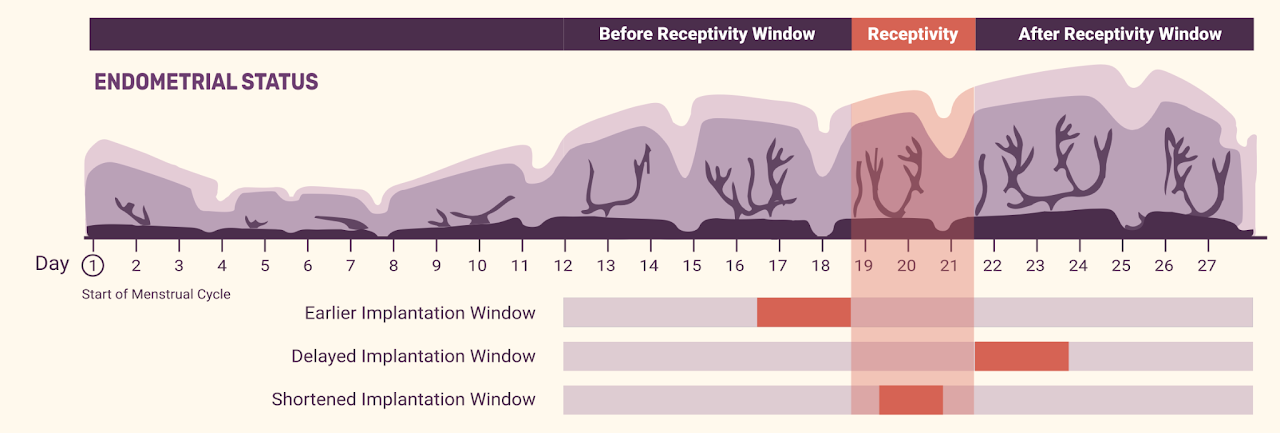
The time when the uterine lining is ready for the embryo to implant is called the Window of Implantation (WOI). It usually falls on days 19-21 of the menstrual cycle, as shown in Figure 1.
Figure 1 The Window of Implantation (WOI) in a normal menstrual cycle, and WOI abnormalities such as a WOI that opens early, opens late, or is shorter than normal (Source:https://intilabs.com)
WOI Abnormalities
In general, when we transfer embryos, we schedule the patient around days 19-21 of the cycle, or day 5-6 after ovulation (or egg retrieval), or day 5-6 after starting vaginal progesterone, or day 7 after a urine test shows the LH surge. The WOI stays open for 30-36 hours. However, as many as 30% of women have an abnormal WOI. The abnormalities found, as shown in Figure 1, are:
A WOI that comes too early (early implantation window), for example starting on day 16 of the cycle instead of day 19
A WOI that comes too late (delayed implantation window). For example, I once had a patient whose WOI started on day 22 of her cycle. Without an endometrial receptivity test, I can promise no IVF doctor in the world would dare to transfer an embryo on day 22. This patient's child should be about 3 years old now.
A WOI that is too short (shortened implantation window), for example a WOI that lasts only 1-2 days instead of the normal 3 days
Some conditions of the uterus and uterine cavity can also make the WOI abnormal. Examples are chronic endometritis, which is common in people with infertility, a dysmorphic uterus, fibroids pressing into the uterine cavity, and endometrial polyps.
How Is the WOI Tested?
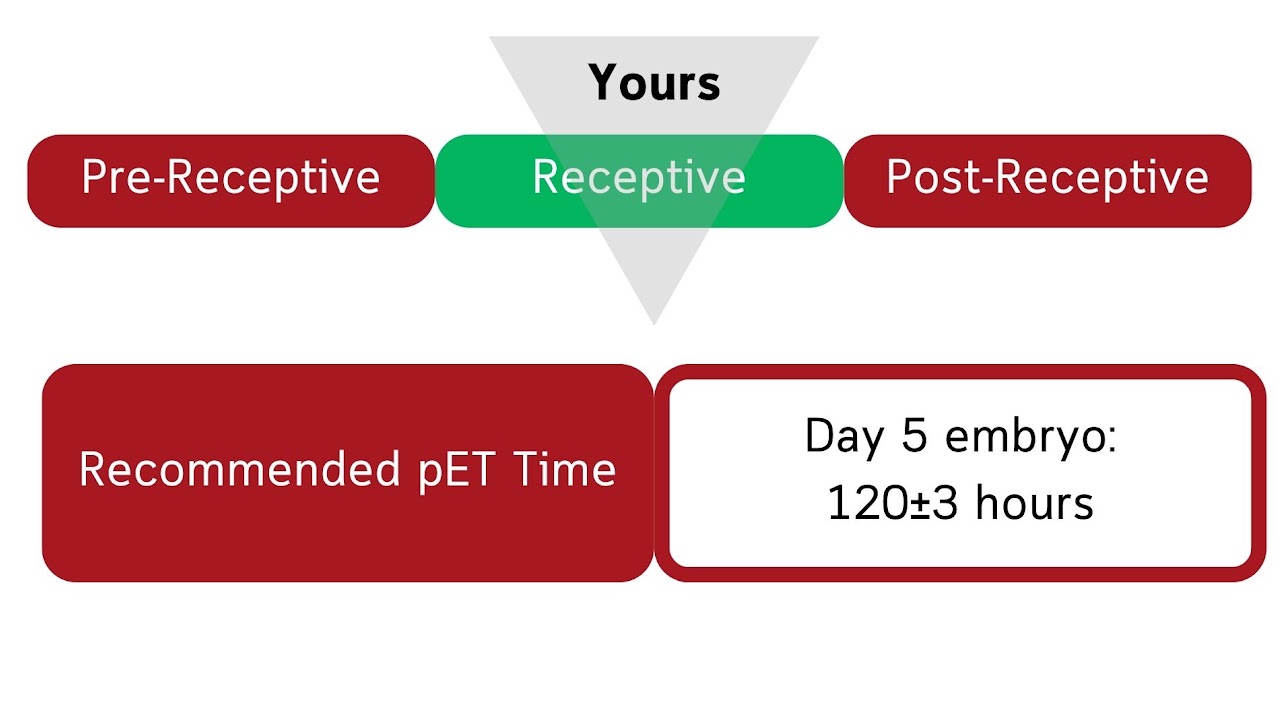
The WOI is tested by looking at the activity of genes in the endometrium that are involved in embryo implantation at the time we would transfer the embryo. Several hundred genes are involved. Their activity is compared with gene activity during the WOI in normal women. The test report is shown in Figure 2.
Figure 2 An endometrial receptivity test report. The top row shows whether the patient's endometrium is receptive, pre-receptive, or post-receptive. The inverted triangle marks the status of the patient's uterine lining. The bottom row shows the number of hours after starting the vaginal medication when the patient's lining is receptive, for a day 5 (blastocyst) embryo transfer.
There are several WOI testing techniques on the market. I divide them into 2 types:
1.Endometrial Receptivity Analysis (ERA)
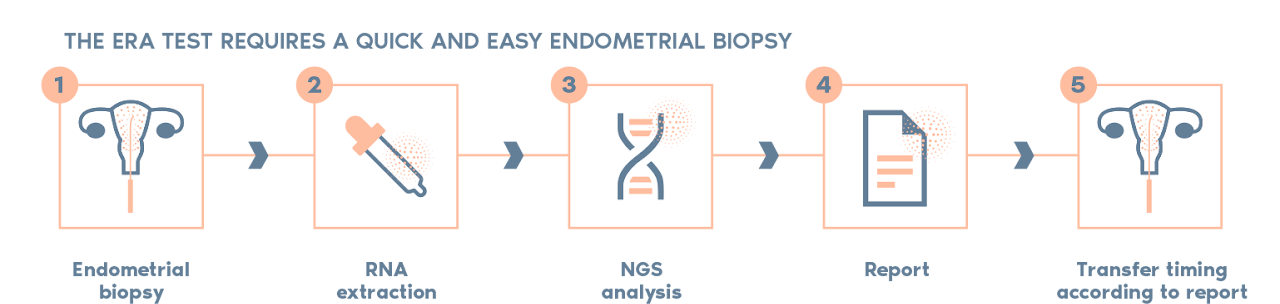
Normally, to check whether a gene is active, we have to take a tissue sample from the area we want to test. ERA uses the same principle. Before the test, the uterine lining is prepared as if for an embryo transfer. Then, 5-6 days after starting vaginal progesterone, a sample of the endometrium is taken for testing, as shown in Figure 3.
The technology used in ERA focuses on mRNA, which is made by active genes. The data on active genes is processed through an AI algorithm, and then the result is reported. Several brands are now available, such as ERA®, which uses NGS technology, and MIRA™️, which uses microRNA technology.
The drawback of this technology is that you have to prepare the uterine lining for one whole cycle without a transfer, just to collect the sample. Taking an endometrial sample can cause lower abdominal cramping and discomfort. Sample collection can also go wrong. For example, too much blood can make the sample impossible to analyze, too much or too little tissue can make it impossible to extract good-quality RNA, or no tissue can be collected at all. You may then need to prepare the lining again.
2. Noninvasive Endometrial Receptivity Analysis
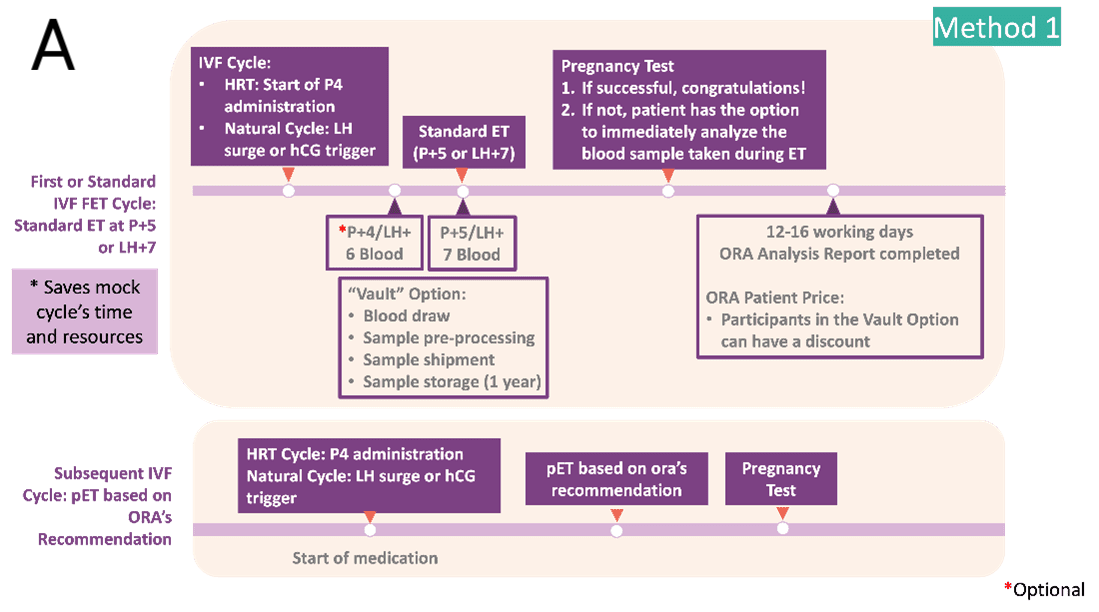
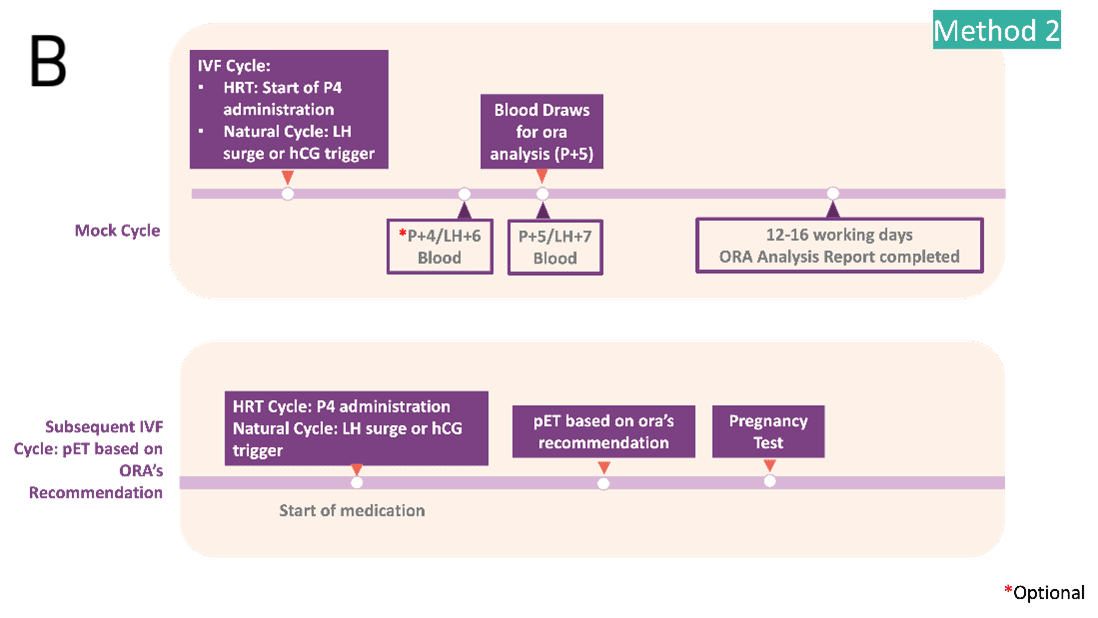
ERA requires an endometrial sample, which is painful, and it costs another menstrual cycle of lining preparation without an embryo transfer. So researchers looked for a way to test without suctioning the uterine lining. There is now technology that finds the WOI from blood by measuring microRNA in the blood. MicroRNA normally works as a regulator of gene activity. This test needs only a blood draw, not an endometrial sample. So the blood can be taken during the stimulation cycle and stored. If the embryo transfer does not lead to pregnancy, the stored blood is then tested (vault option). Or you can prepare the lining in another cycle and do an ERA-style test. If the vault option lab test is arranged in advance, we get the information early and can prepare the lining for embryo transfer right away, without spending time on a separate preparation cycle, as shown in Figure 4.
Figure 4 The steps of a noninvasive endometrial receptivity test. A.Vault option: a blood sample is collected in the first embryo transfer cycle but not fully tested yet. If the first transfer does not implant, the same blood sample can be tested right away. B. Standard separate lining preparation to test for the WOI (Source:https://intilabs.com/ora-clinic/)
Who Should Be Tested for the WOI?
Most patients can get pregnant from an embryo transfer at the usual timing without an ERA test. Testing every patient with ERA is not useful and not necessary. ERA testing is recommended in the following cases:
A history of embryo transfers that did not implant, or a history of miscarriage (after other uterine causes have been checked)
Few good-quality embryos
Body weight that is too low or too high
Age 35 or older
What Are the Precautions?
As I mentioned above, some diseases and conditions can disturb the WOI. So before WOI testing, we must first make sure you do not have any of the following conditions. If any of them is found, it should be treated first, and WOI testing done 2-3 months later. Diseases and conditions that may affect the WOI include:
Endometriosis
Chronic endometritis
Congenital malformation of the uterus, including dysmorphic uterus (dysmorphic T-shaped uterus) and septate uterus
Endometrial polyp, a condition linked to both chronic endometritis and congenital malformation of the uterus
Fibroids pressing into the cavity (submucous myoma)
Summary
WOI testing is needed only for people who have had chromosomally normal embryo transfers that did not lead to pregnancy, after uterine causes such as fibroids or congenital anomalies like a dysmorphic uterus have been looked for and corrected. Today the test can be done with a blood draw, which makes it more convenient.
References
ESHRE Add-ons working group, K Lundin, J G Bentzen, G Bozdag, T Ebner, J Harper, N Le Clef, A Moffett, S Norcross, N P Polyzos, S Rautakallio-Hokkanen, I Sfontouris, K Sermon, N Vermeulen, A Pinborg, Good practice recommendations on add-ons in reproductive medicine, Human Reproduction, Volume 38, Issue 11, November 2023, Pages 2062–2104, https://doi.org/10.1093/humrep/dead184
* This article is general health education. Diagnosis and treatment should be guided by your doctor. Results vary with age and individual medical factors.
Dr. Patsama Vichinsartvichai, MD, MClinEmbryol, EFOG-EBCOG, EFRM-ESHRE/EBCOG, FACOG is a board-certified reproductive endocrinology & infertility specialist, former head of the Vajira IVF unit at Navamindradhiraj University, and founder of LIFE by Dr. Pat in Bangkok. His published research focuses on the dysmorphic (T-shaped) uterus and uterine-factor infertility.
 LIFE by Dr. Pat